Can a Hole That Slides Read a Molecule?
Slide one thin membrane across another and the hole between them changes size while it works. We checked the geometry, the patent and the prior art against the hope that such a pore could one day read DNA.
A strand of DNA pulled through a bare hole in a silicon nitride membrane moves at one to a few tens of nucleotides per microsecond, which is a million to ten million bases a second. Each base spends less than a microsecond in the narrowest part of the hole, and over a microsecond the current through a pore is too noisy to say which base went by. Solid-state pores have been recording DNA since 2001. No group has yet published one that reads a strand base by base.
Protein pores got around the speed problem with a motor. An enzyme parked at the mouth of the pore feeds the strand through in steps of about half a nanometer, slowly enough for each step to register as its own current level; the Akeson lab at UC Santa Cruz titled its 2012 paper on the method "Automated forward and reverse ratcheting of DNA in a nanopore at 5-Å precision." Commercial nanopore sequencers still depend on motor proteins. A hole cut in a ceramic film has nowhere to put one.
Molecular Reality Corporation, which Kent Kemmish and Charles Gaillard founded in 2018 as demonpore, inc., wants to move the hole itself. The company's FAQ, written in the voice of a green felt puppet named Keltar, gives the definition:
A juxtapore is a pore formed by two surfaces sliding alongside each other, their edges close enough to form the sensing gap. Adjust the position of the surfaces and you adjust the gap itself. This is sliding occlusion: mechanical control of the pore's size, in real time, by moving solid parts.
"Juxtapore," the puppet adds, "is our own word." The answer to the question in our headline is that a sliding hole has not read a molecule yet, and neither has any other solid-state pore. Whether one could comes down to geometry, and to a family of adjustable pores that is older than the word.
Where the idea came from
The founder's own records date the idea to 2012, "when I first thought of mechanical nanopores." He had spent 2009 to 2012 on the founding team of Halcyon Molecular, which was working on DNA sequencing by electron microscopy, and he is a co-author, with George Church among the others, of a 2013 paper in PLoS ONE titled "Molecular Threading: Mechanical Extraction, Stretching and Placement of DNA Molecules from a Liquid-Air Interface."
The name came about three years after the idea. A post on the company's message board, written in the voice of its mascot Maxine, says that when the founder explained "his concept for sliding-occlusion-based dynamic mechanical nanopores, it reminded a colleague of those little cartoons" of Maxwell's demon, the imagined doorkeeper who sorts molecules by opening and shutting a gate between two chambers. Maxwell called it a "being." The word "demon" was William Thomson's, in 1874.
Two sheets and a gap
The idea is set out in US Patent 10,908,144 B2, "Stacks of coaligned nanopores and fabrication and uses thereof," with the founder as sole inventor. Its first claim covers "a stack of at least three longitudinally aligned nanopores in an equivalent number of stacked solid membranes." The membranes are free to move sideways, so moving one changes how the holes line up and the shape of the passage through them, and at least two of the membranes must differ in thickness. According to the abstract, the stack offers three benefits: a wider range of analyte sizes, control over how molecules pass through, and "regeneration of an appropriate sensor geometry in the event of corrosion or clogging."
The application claims priority from May 9, 2017, was filed a year later and was granted on February 2, 2021. Google Patents lists the patent as expired because a maintenance fee was not paid, with the lapse taking effect on February 2, 2025. In a post on the company's message board in March 2026, the founder wrote: "I don't pitch the project anymore with any reference to 'our IP portfolio'."
A lens, a slot and a square
The definition hides a piece of geometry. Slide two membranes with round holes 100 nm across over each other and the opening is the overlap of two circles, a lens, which narrows along the direction of travel much faster than it shrinks across it. At an offset of 95 nm the lens is 5 nm wide and 31 nm long. At 98 nm it is 2 nm wide and 20 nm long, a slot ten times longer than it is wide.
That is a problem for reading molecules. A DNA double helix is about 2 nm thick, so a slot that pins it in one direction leaves it free to wander along the other, and most of the current flows around it.
Square holes behave better. Two square windows slid diagonally, by the same distance in both directions, overlap in a square: 100 nm squares offset by 95 nm each way leave an opening 5 nm on a side. Silicon makes square windows without being asked. Hot potassium hydroxide etches silicon along its crystal planes and stops at walls that meet the surface at 54.74 degrees, the arccosine of one over the square root of three, so a window etched through a wafer comes out square, at the bottom of a pyramid.
The seam between the sheets
A sliding stack has a leak that a fixed pore lacks. Ions in any gap between the two sheets can travel from one hole to the other without passing through the overlap. Our rough estimate, not the company's: a film of 1 M potassium chloride one nanometer thick, at the conductivity of bulk salt water (about 11 S/m at room temperature), has a sheet conductance of about 11 nS per square. A whole 5 nm pore in a 10 nm membrane conducts about 15.5 nS. A seam a nanometer thick, about as long as it is wide, would carry nearly as much current as the pore it is meant to define.
Water films that thin do not conduct exactly like bulk salt water, but they conduct; the Geim group at Manchester measured potassium chloride moving through slits only 6.6 Å tall (Esfandiar and colleagues, Science, 2017). The patent's abstract calls for "directly stacked" membranes, and how flat and tight that contact is will decide how much of the measured current comes from the hole.
Moving a membrane by nanometers
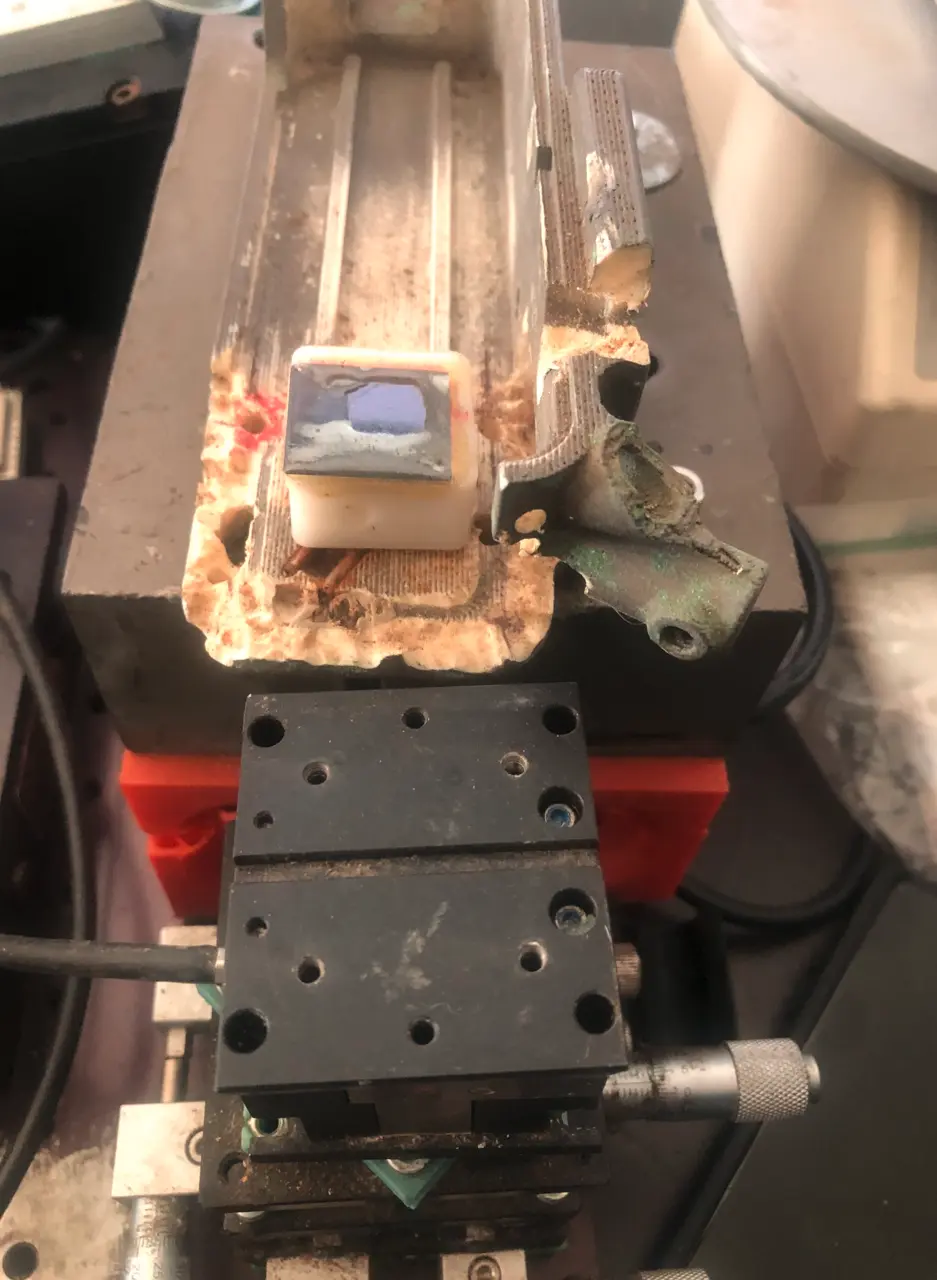
Moving solid parts by nanometers is an old skill. Closed-loop piezoelectric stages position to well under a nanometer, and thin-film piezoelectric benders about 100 µm long move tens of nanometers per volt. Electrostatic actuators are simpler to make and come with a trap: a parallel-plate actuator snaps shut once it has closed a third of its gap, a limit engineers have designed around since Nathanson's resonant-gate transistor of 1967. The photograph at the top of this article shows one of the company's older rigs, a pore chip glued to the end of a rail above a stage driven by a micrometer screw.
Company materials say the overlap can be positioned to better than 5 nm. That is a figure for the stage, and it is easy to read as a figure for the hole. A hole bounded by two edges is only as clean as the edges are, and edges cut by an ion beam or a laser are rough at the nanometer scale. The company calls apertures below 15 nm a target for a later device. The pore on its live stream is a laser-drilled hole 200 µm across; in the FAQ's words, the pores it streams today "are larger than a nanometer."
A seventy-year-old family
Pore sensing itself is older than the sliding. On August 27, 1949, Wallace H. Coulter of Chicago filed a patent titled "Means for counting particles suspended in a fluid," granted on October 20, 1953, as US 2,656,508. Two chambers of salt water are joined through one small aperture, and a current runs between them. A particle in the aperture displaces conducting fluid, the resistance rises and the current dips. When the particle is much smaller than the aperture the dip scales with its volume, a relation DeBlois and Bean used in 1970 to count and size particles smaller than a micrometer. Coulter's apertures were about 100 µm across and counted blood cells, and hematology analyzers in hospitals still count cells that way.
Shrunk by five orders of magnitude, the same aperture is a nanopore. In 1996 a team that included the Branton lab at Harvard and the Deamer lab at UC Santa Cruz drove single strands of DNA and RNA through alpha-hemolysin, a protein pore. In 2001 the Golovchenko group at Harvard sculpted holes in silicon nitride with an ion beam. The company's FAQ places itself on this line without fuss: "We are not the first, and we are not pretending to be. We are a small branch on a seventy year old tree, and the tree is wonderful."
Adjustable pores before this one
Pores that change size are not new either. In 2007 Sowerby, Broom and Petersen described "dynamically resizable nanometre-scale apertures for molecular sensing" in Sensors and Actuators B: a hole punched in an elastomeric membrane, opened and closed by stretching it. Izon Science, in Christchurch, New Zealand, has sold instruments built on that principle since 2009 under the name tunable resistive pulse sensing; its qNano was succeeded by the Exoid in 2021. The same year as the Sowerby paper, the Takayama lab at the University of Michigan made nanochannels by stretching silicone rubber until its oxidized skin cracked, and set their width with the strain (Huh and colleagues, Nature Materials, 2007). Physicists who measure the conductance of single molecules have adjusted metal gaps with sub-ångström control since the early 1990s, by bending a substrate under a notched wire.
What the stack adds is narrower. Its membranes are rigid films and its aperture is set by sliding them, where the older devices stretch something soft or bend something thin, and a ceramic membrane can be moved but not stretched.
The record so far
None of the company's evidence has been through peer review. It is in videos, posts on the message board and the company's own records.
Of these, the 2018 afternoon is the best documented. The founder's post about it describes a hole about 200 nm across, drilled in silicon by an outside fabricator, and two colleagues running the experiment while he was elsewhere: "You see the current trace moving up and down as the top blade slides across it." Each pore cost about $100. In the first week or so of trying to find the right wetting protocol, the team broke most of them.
The blood came later that year. "I grabbed a razor blade and bled into the flow cell," the founder wrote of the first time the team put blood through one of its pores (rain of blood is the company's name for the episode). Years afterward an analysis of those runs asked whether the approach helps tell apart particles of similar size. "The simple answer was 'yes', though many hours of focused work would be needed to actually publish any of this in a convincing way."
What a moving wall could add
Fixed solid-state pores are less passive than they sound. A voltage reversed within milliseconds pulls a DNA molecule back through the pore it has just left (Gershow and Golovchenko, 2007). The Keyser lab at Cambridge has passed a single DNA carrier back and forth through a glass nanopore more than a hundred times (Zheng and colleagues, 2023), and an industry team working with the Reisner lab at McGill has flossed DNA between two fixed pores. Rereading reduces random noise by the square root of the number of reads, so a hundred reads buy a factor of ten.
A sliding stack can do one thing those devices cannot, which is open. Clogging is a routine way for a fixed pore to fail, and the usual remedies are voltage pulses and harsh cleaning. A juxtapore, in the company's description, opens to flush debris and closes again; that is the "regeneration" in the patent's abstract. The same motion gives one device a wide range of sizes, since company materials describe a single juxtapore opening to tens of micrometers. The FAQ proposes a third use, the one that bears on reading: "a pore you can widen to admit a molecule, then narrow to hold it, then release, a valve with molecular fingers."
Not yet
Holding a molecule still for long enough to read it is the step between sliding occlusion and sequencing, and no one has shown it with a juxtapore. The FAQ says so plainly: "Reading every base of DNA in order, true sequencing, is the grand prize of the whole solid state field. No solid state pore has done it commercially yet." It closes the answer with "When we can hold a molecule gently, we can read it. That is the plan, and I flag it as a plan."
Physics does not rule the plan out. A slot narrower than a double helix can hold a strand, and a stage that positions to a few nanometers could in principle close on one. Between that and a read lie the seam, the roughness of the edges, a stage that moves in milliseconds against molecules that cross in microseconds, and the problems the founder files under dumb. "The biggest, ugliest, dumbest one," he wrote in March, "is: how do you get water through the pore?"