Molecular Reality Open-Sources a Nanopore Reader It Has Not Built Yet
The design files for a desktop solid-state nanopore instrument went up on GitHub on Friday under the AGPL: CAD models, four circuit boards, firmware and a test suite. What the repository does not contain is a measurement.
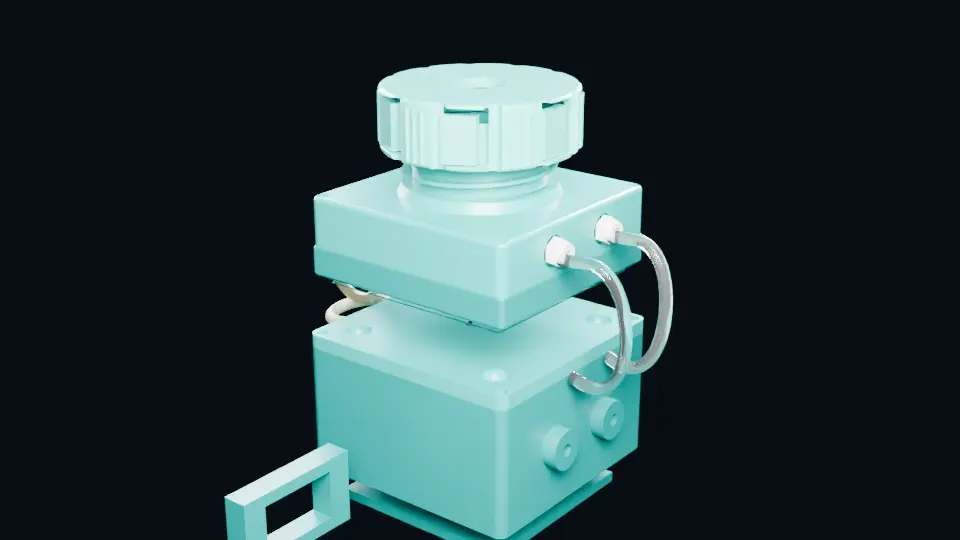
Molecular Reality Corporation, the nanopore company that called itself demonpore, inc. until 2021, published the design files for a desktop instrument that reads single molecules on GitHub on Friday. The citation file gives the version as 1.0.0, the release date as October 16, 2026, and the license as AGPL-3.0-or-later.
Nobody has built one. The repository holds parametric CAD models written in Python with build123d, KiCad files for four circuit boards, firmware for an ESP32-S3 microcontroller, a casting guide for silicone gaskets, a bill of materials and a large automated test suite. It holds no recording from the instrument, because there is no instrument to record from.
The tests are real, and they pass. A badge at the top of the README reads "95 Passing (0 Collisions)". The collisions are geometric: the suite checks the 3D model of every part against its neighbors, and the documentation says the project "enforces zero physical interference and strict dimensional fidelity across all hardware interfaces."
The README's first sentence aims higher. It calls the system "an open-source, ultra-low-noise solid-state and biological nanopore sequencer flow cell, low-current transimpedance amplifier, and automated fluidic control system."
What the files describe
The design has four modules. A pump and power board negotiates USB-C Power Delivery, runs two peristaltic pumps and reads two pressure sensors. A reader board, built around an ESP32-S3, runs what the README calls "a continuous 100 kHz SPI DMA data acquisition sequence" and uses an MCP4822, a two-channel DAC, to set the voltage across the membrane. The cartridge is a hexagon: a 4 by 4 mm silicon die holding the pore, sealed between cast silicone gaskets on a PTFE and Rogers interposer board, with gold-plated pogo pins reaching down to a small amplifier board mounted directly underneath.
That amplifier is the part readers of this site will look at first. Its transimpedance stage is built on Texas Instruments' LMP7721. The README credits the chip with "sub-femtoampere leakage"; the manufacturer's datasheet gives a typical input bias current of 3 femtoamperes and a maximum of 20, which at the typical figure is one electron about every 50 microseconds. Nanopore currents are ten thousand to ten million times larger, from tens of picoamperes for a small pore up to tens of nanoamperes for a large one. For the whole cell, a four-electrode design with driven guard traces, the README promises "sub-picoampere sensitivity". Nothing in the repository yet shows how the board behaves on a bench, and a bench is the only place that promise can be checked.
The cartridge also carries what the README lists as a "Conductive Weep Moat / Leak Detection Sensor", wired to a hardware interlock that shuts off the pump motor drivers if salt water gets out. A device that pumps electrolyte directly above a femtoampere amplifier needs one.
At 100,000 samples per second the reader would take one point every 10 microseconds. The company's live stream already samples at twice that rate on a bought instrument, an EDR4 patch-clamp amplifier that the company's FAQ calls "the laboratory's ear". As of August the stream archive held eighteen recordings.
One README, several names
The repository went public under a different name. Its README opens with "Sentinel Nanopore Reader (Daemon Pore)", and the citation file is titled "Sentinel Nanopore Reader: An Open-Source Low-Noise Solid-State and Biological Nanopore Sensing Platform". The name MR1 belongs, for now, to the reader board inside the stack and to its firmware folder.
Dates come from the commit history. The first commit, on November 11, 2025, has the message "first commit". Six weeks later, on December 23, a commit titled "Add Sentinel Nanopore Reader Rev 11 SCAD file" added revision 11 of the design as an OpenSCAD file. The release preparation landed on Thursday, October 15, in a commit that put the AGPLv3 header on the source files and, in its own words, "temporarily skips specific KiCad build verification tests until CI support is available."
Of the more than 400 commits in the history, 143 were made by the bot account of an AI coding agent. The rest come from the engineer who leads the hardware design. The company is small: a caption in its own materials from July counts three people.
"Daemon Pore" is the old company name, respelled. Demonpore, inc. was named for Maxwell's demon, the thought experiment in which a tiny gatekeeper sorts molecules at a door between two chambers. The company also has an older device called MR1, a red handheld molecular streaming device that its FAQ describes as "one of several prototypes the team has built over the years". Both MR1s use the same microcontroller and the same amplifier chip.
The license
The AGPL is a copyleft license. Anyone may build and sell the design, and anyone who distributes a modified version has to release it under the same terms, with its source. That is a different promise from some of the company's older copy, which said in February: "We want to be radically open, our schematics and protocols will all become public domain." The GNU Affero General Public License and the public domain are not the same place. The 2021 patent behind the company's sliding-pore idea lapsed in February 2025.
Update, October 18, 2026: A commit titled "refactor: Rename Daemon Pore/Sentinel to MR1 across codebase" changed 71 files. The README now opens "MR1 Nanopore Reader (MR1)", the citation file's title begins "MR1 Nanopore Reader", and the test badge reads 100 passing.
Update, October 21, 2026: The project now states its status in a single line: "Designed. Simulated. Built and measured: not yet."
Update, October 21, 2026: A commit titled "Relicense project to Public Domain under CC0 1.0 Universal (CC0-1.0)" placed the whole project in the public domain, replacing the AGPL. The design is now where the company's February copy said it would be, five days after the release.